

Search Here
What is OneDose, and how does it work?
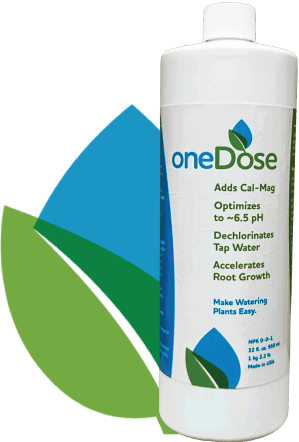
OneDose is water conditioner concentrate that simplifies preparing water for plants for a pH around 6.5, adding Cal-Mag, and removing chlorine and chloramines, while using only tap water. It represents a new approach to promoting plant growth by maintaining an optimum pH for certain plants to maximize nutrient uptake. Instead of giving them more NPK, make it easier for the plants to uptake the soil’s nutrients.
How do I use OneDose?
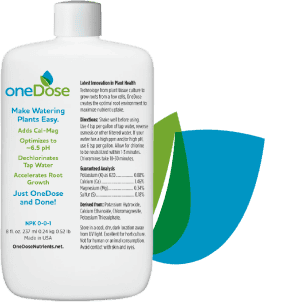
Use 5 ml per quart of tap water, reverse osmosis or other filtered water. If your water has a high ppm or high pH, it may be necessary to use 7ml per quart to get the pH to 6.5. Chlorine is neutralized in a few minutes. Chloramines takes 10-30 minutes. In comparison, sitting tapwater without OneDose takes 24-48 hours for chlorine and weeks for chloramines to naturally break down.
How much OneDose should I use per gallon of water?
Follow the dosing instructions on the product label for the best results. Use 20 ml or 4 teaspoons per gallon of water. If the water has a high TDS or a very high pH, increase, as needed, up to 6 teaspoons per gallon.
Will the OneDose work with any nutrient line?
Yes, The OneDose was specifically designed to not replace the NPK and other nutrient regimens. The OneDose only replaces the water preparation steps of balancing pH, removing chlorine, adding CalMag, plus, don’t forget, the root growth agent. If you used a super soil or living soil, you may not need additional feedings, as the OneDose optimizes nutrient uptake. If you are on an NPK feeding schedule, carry on with that schedule, if needed.
How will the OneDose provide the right amount of calcium and magnesium?
To develop the OneDose, we analyzed tap water sources from across the USA. We adjusted the Calcium and Magnesium on the OneDose to be used with the average tap water in the USA. The treated tap water is targeted to have a 100 ppm of calcium and 25 PPM of magnesium.
Does OneDose add nitrogen? What is the NPK?
The OneDose adds no nitrogen. It has an NPK of 0-0-1, plus 0.2 Sulfur.
What justifies the cost?
The formula uses laboratory compounds used in plant tissue culture or micropropagation. These cutting edge compounds are still expensive. As this new technology migrates from the laboratory to production horticulture, the future may have lower costs from economies of scale.
How does OneDose adjust the pH of water?
OneDose contains buffering compounds that target a pH between 6.1 and 6.5 when using treated municipal tap water.
How does OneDose remove chlorine and chloramines from tap water?
OneDose contains a potassium-sulfur compound that neutralize chlorine and chloramines, making the water safe for plant use. Do not use aquariums dechlorinators as they produce ammonium and formaldehyde, which are harmful for plants, and they contain sodium salts contributing to nutrient lockout.
What types of plants can benefit from using OneDose?
It benefits a wide range of plants, including bonsai, orchids, exotic plants, vegetables, cannabis, and potentially mushrooms. Most plants thrive in a slightly acidic environment with plenty of calcium and magnesium. Plants that prefer soft water with low mineral content or prefer a very acidic soil, such as blueberries. Compared to using tap water alone, OneDose water will make almost every plant healthier.
Is OneDose safe for all types of plants?
Yes, the OneDose is formulated to be safe for plants that can tolerate a water and soil pH of 6.1-6.6. If there are specific concerns, please contact support. We would be happy to help tailor your application.
Are there any plants that should not be treated with OneDose Nutrients?
It is generally safe for most plants that prefer a slightly acid soil at or below 6.5 pH. See Plant Applications
How often should I use OneDose on my plants?
Use OneDose every time you water your plants for consistent benefits.
Can OneDose be used for propagating clones and cuttings?
Yes, but at a diluted amount of 1ml/quart.
Can OneDose be used for both indoor and outdoor plants?
Yes, it is effective for both indoor and outdoor plants.
How do I know if my tap water needs treatment with OneDose?
All tap water in the USA contains chlorine or chloramines, which need to be removed before feeding plants. Make sure your plant species favor the slightly lower pH. Most love it!
How do I know if my tap water has chlorine or chloramines?
Given that you need to allow for a 1-3 minutes for the OneDose to disinfect chlorine from tap water and 10-30 minutes to neutralize chloramines, it is useful to know what disinfectants are used by your local water provider. A search of “[NAME + CITY/COUNTY) drinking water quality using chlorine or chloramines” on https://chatgpt.com/ has provide the answer. For example, search for “Dekalb County drinking water quality using chlorine or chloramines”.
What are the benefits of using OneDose compared to other water treatment products?
Save time and money with one bottle to do it all. Why buy a bottle of Cal Mag, one for pH Up, a bottle of pH Down, when you can just buy one bottle of the One Dose? There are no others like the One Dose.
Does OneDose also adjust the pH of the water?
Yes, it balances the pH to a slightly acidic level typically close to or below 6.5, ideal for many plants.
What is the pH range of the treated water after using the OneDose?
The ideal pH range it targets is slightly below 6.5, which suits most plants. The pH range is 6.1-6.6.
What is the pH range of the source water before using the OneDose?
The ideal pH range of the source water is US tap water. It has been tested with water between 6.5 and 9.9 pH with more solution being required for higher pH and higher TDS water sources. A higher TDS reduces the ability for the solution to adjust the pH.
What is the difference between OneDose and manually adjusting pH with pH Up and pH Down?
When you manually adjust the pH, you are only getting the water to the desired pH without any ability for that water to maintain the pH, especially once it goes into soil. OneDose provides a buffer to stabilize the pH to around 6.5. It does not break down immediately in the soil, whereas, the manually adjusted pH will quickly revert.
How does the OneDose promote root growth and increase yields?
It includes a compound typically used in plant tissue culture and micropropagation that enhances root development and overall plant health, leading to better flower. Recent research has shown a 17% increase in lettuce yields using the same compound.
Can the OneDose be used in hydroponic systems?
This version of the OneDose was designed for soil or coco. The calcium and magnesium in the OneDose feed microbial development. Although it can be used in Hydroponics, it was not designed for that application.
Can the OneDose be used in soil?
Yes, the One Dose is recommended for use soil systems, because it feeds microbial development in the soil.
Why not use water conditioners with citric acid?
Citric acid will “drop the pH – generating citrate ions in the process – these will then be absorbed by microbes and plants, increasing the pH again rapidly,” as explained by an expert in hydroponics research (https://scienceinhydroponics.com/2020/05/a-guide-to-different-ph-down-options-in-hydroponics.html). Amazingly, numerous water conditioning products sold for hydroponics use citric acid to adjust pH. The same issue applies in soil, citric acid will not maintain the pH at ideal levels.
How should the OneDose be stored to maintain its effectiveness?
Store it in a cool dry place. Avoid UV light exposure. Do not use a syringe or other inserted object that may contaminate the bottle.
Is the OneDose organic?
No. Although an organic formula was the original requirement, it was not chemically possible to make the OneDose an organic formula. The organic compounds quickly degrade in soil and feed microbes, reducing the ability to balance the pH and deliver cal-mag.
What are the ingredients in OneDose?
The One Dose provides: 0% Nitrogen, 0% Phosphorous, 0.9% Potassium, 0.2% Sulfur, 0.4% Magnesium, 1.6% Calcium. Derived potassium hydroxide, calcium
ethanoate, chloromagnesite, and potassium thiosulphate.
How long does it take to see results after using the OneDose?
Save time and money immediately. See happy plants in weeks.
Can OneDose be used with other fertilizers or plant supplements?
Yes, it can be used alongside other fertilizers and supplements, unless they contain pH regulating compounds, which is rare.
Where can I purchase OneDose Nutrients?
You can purchase it through our website, and we offer international shipping options.
Is it available for international shipping?
No. Not at this time.
How to become a dealer or make a wholesale purchase?
We welcome a partnership. See Become a Dealer.
Is OneDose safe for human or animal consumption?
No, OneDose may only be used for water to provide to plants. Humans or animals should not consume the OneDose or water treated with OneDose.
Can I use aquarium water conditioners to remove chlorine and chloramines?
No. Products that neutralize chlorine and chloramines for aquariums typically use either sodium thiosulfate (API Tap Water Conditioner) or sodium hydroxymethylsulfinate (Tetra Aquasafe), which produce ammonium and formaldehyde, respectively, as byproducts from the neutralization. Ammonium and formaldehyde are harmful for plants. They also add sodium salts to the water. With on-going watering, these salts build up in the soil, which could lead to nutrient lock out for your plants. OneDose does not include any sodium salts. Instead, we use potassium thiosulphate to remove chlorine and chloramines, which also provides beneficial potassium for plants without the harmful byproducts.